
Laser Cutting vs Chemical Etching: Which Is Better for Precision Parts?
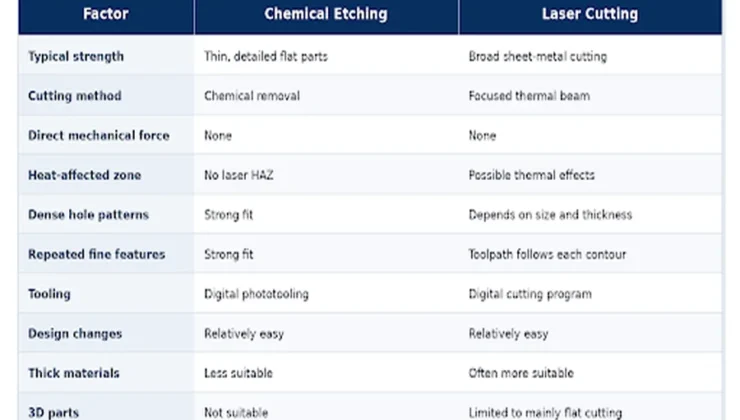
Choosing the right process for a precision metal part is not only about price. Material thickness, feature size, geometry, heat effects, production volume, and future design changes all matter. Laser cutting and chemical etching can both produce flat metal components, but they work in very different ways. Understanding those differences helps engineers select the process that best matches the part.
How Laser Cutting Works
Laser cutting uses a focused beam of light to heat a narrow area of metal. The energy melts or vaporizes the material along a programmed path, while assist gas helps remove material from the cut.
Because the laser follows a digital toolpath, engineers can change the cutting geometry without creating a physical cutting die.
Laser cutting works across a broad range of sheet-metal applications. It is often useful for larger profiles, thicker materials, prototypes, and parts with relatively simple outlines.
However, it is a thermal process. Depending on the material, thickness, settings, and feature geometry, heat can affect the area close to the cut edge.
How Chemical Etching Works
Chemical etching, also called photochemical etching or photo etching, removes selected areas from a metal sheet using a controlled chemical reaction.
The metal is first cleaned and coated with a light-sensitive photoresist. Digital artwork defines the required part geometry. Ultraviolet exposure transfers this pattern to the coated sheet.
After development, the unprotected metal is removed by an etchant. The remaining parts are stripped, cleaned, and inspected.
This process can create holes, slots, grids, apertures, tabs, identification features, and complex outer profiles in the same flat component.
Unlike laser cutting, chemical etching does not use a concentrated heat source to create the profile. It also avoids direct mechanical cutting force.
Laser Cutting vs Chemical Etching
The better process depends on the design.
Neither process is automatically more precise or more economical in every case. Part geometry and manufacturing requirements should drive the decision.
When Chemical Etching Makes More Sense
Chemical etching becomes attractive when a component is thin and contains many small or repeated features.
Consider a fine metal screen with hundreds of openings. A laser must trace the programmed contours, while etching exposes and processes the pattern across the sheet.
The same principle applies to slots, grids, apertures, coded patterns, and complex outlines.
This is why the process is often considered for parts such as encoder disks, electrical contacts, precision shims, sensor plates, fine screens, lead frames, and EMI shielding.
It is also useful when mechanical deformation or laser-related thermal effects would be undesirable.
Complex Features in Thin Metal
A single etched part can combine:
- Small holes.
- Narrow slots.
- Fine grids.
- Mounting tabs.
- Apertures.
- Complex external profiles.
- Identification marks.
- Half-etched features.
These features can be included in the same digital artwork.
Frequent Design Changes
Precision parts often change during prototype and validation stages.
An engineer may change a hole diameter, move a tab, adjust a screen pattern, or modify the outer profile after testing.
Chemical etching uses digital phototooling, so many design changes can be made by updating the artwork rather than building a new hard stamping die.
This can be useful for prototypes, engineering validation, pilot builds, and product families with several related versions.
When Laser Cutting Is the Better Choice
Laser cutting has clear advantages in other situations.
It can be a better option for thicker sheet metal, larger components, simple profiles, and low-volume parts where very fine repeated features are not the main design challenge.
Laser systems can also move quickly from CAD data to cutting without chemical processing or photolithography.
For example, a large mounting plate with a simple outer shape and several large holes may not benefit from photochemical etching. Laser cutting may provide a more straightforward manufacturing route.
The key is to avoid choosing a process based only on familiarity.
What About Stamping and CNC Machining?
Laser cutting and chemical etching are not the only options.
Stamping can be highly economical for simple components produced in very large quantities, especially when the design is stable enough to justify hard tooling.
CNC machining is better suited to many thick parts, three-dimensional features, pockets, threads, and structures that cannot be created from a flat sheet.
The manufacturing decision should therefore compare all realistic processes rather than treating laser cutting and etching as universal alternatives.
Common Parts Made by Chemical Etching
Chemical etching is particularly useful when many detailed features must fit into a thin metal component.
Common examples include:
- EMI and RFI shielding.
- Encoder disks.
- Precision shims.
- Electrical contacts.
- Flat springs.
- Sensor apertures.
- Fine screens.
- Lead frames.
- Thin thermal-management structures.
Some applications, such as thin vapor chambers, can also use etched internal channels or patterns as part of a wider manufacturing and assembly process.
Five Questions to Ask Before Choosing a Process
Before selecting laser cutting or chemical etching, engineers should answer five practical questions:
- How thick is the material?
Very thin materials often make chemical etching more attractive, while thicker sheet may favor laser cutting. - How small are the features?
Dense apertures, fine grids, and narrow slots can change the economics and feasibility of each process. - How many repeated features are there?
A part with hundreds of openings presents a different manufacturing challenge from a simple bracket. - Will the design change?
Both processes use digital data, but the complete tooling and production workflow should be considered. - What volume is required?
Prototype quantity, annual demand, material utilization, inspection, and secondary operations all affect total cost.
Which Process Should You Choose?
Laser cutting and chemical etching serve different manufacturing needs.
Laser cutting is often a strong choice for thicker sheet, larger components, and relatively simple profiles. Chemical etching is especially useful for thin, complex flat parts with many small or repeated features.
The best decision comes from reviewing material, thickness, geometry, tolerance, volume, heat sensitivity, secondary operations, and total manufacturing cost together.
Rather than asking which process is universally better, engineers should ask a more useful question: Which process fits this specific part best?