Integrating Ai Into Medical Education
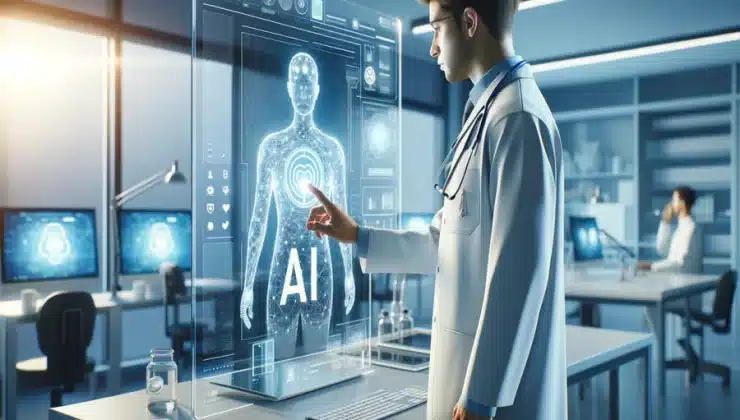
Artificial Intelligence (AI) is no longer a science fiction story but a part of our lives, with healthcare pushing the boundaries. One of the most exciting varieties of AI that is commercially available right now is generative AI, which has already made huge leaps in health care. So, how is generative AI used in healthcare?
Here’s a closer look at what generative AI is, what it does in healthcare and how it’s impacting the way the next generation of doctors and healthcare workers are being trained.
What is Generative AI?
Generative AI is the technology responsible for creating new things, such as text, images, or audio, based on pre-existing models it has trained on. Generative AI includes the likes of applications like ChatGPT. They can write up medical explanations, answer difficult questions, and even recreate doctor-patient interactions. At the risk of oversimplification, generative AI helps by “generating” useful content that helps us learn and solve problems.
How Is Generative AI Utilized in Healthcare?
Among the first questions is typically: How does generative AI benefit healthcare? And, you know, it’s being used in very creative ways. For instance, AI can now assist in writing patient reports, condensing massive amounts of information, as much as a doctor would fill out in one week, instantaneously. It can even generate images of organs or disease to inform doctors what they are dealing with. In planning surgeries, it can even generate simulations of different treatments to help doctors choose the safest path. AI chatbots are also being used to answer patient inquiries, book appointments, and remind patients to take their medication.
AI in the Medical Classroom
Medicine is one of the hardest things to train in. You have to take in an immense amount of information and perform complex procedures. This is where AI makes for a helpful teacher.
Generative AI should enable students to receive explanations of difficult topics in layman’s language. If a student is struggling to comprehend how a medication works in the body, they can ask an AI to explain it in layman’s terms. The tool can repeat it, again and again, until the student understands.
Practicing With Virtual Patients
One of the most captivating uses of generative AI in medical education is the creation of virtual patient sims. They’re not real people, but simulations of patients who respond to questions as if they were. Students can talk to them, take their histories, ask about symptoms and diagnose them.
This allows would-be doctors to practice communicating and deciding without actually breaking a bone. It also gives them more confidence before they treat real patients in clinics or hospitals.
Improved Preparation for Actual-Life Challenges
Generative AI also helps students to be up to date with modern medical knowledge. While medical science changes, textbooks will quickly become obsolete. AI programs can gather and summarize the most recent research, so students and faculty can stay up-to-date with the latest information.
Challenges and Ethical Concerns
Generative AI provides us with many benefits, but it’s worth using with our eyes wide open. AI is not foolproof, and at times, can provide incorrect or biased information. That’s why human teachers and experienced doctors remain vital. They will have to instruct students how to use AI responsibly.
There’s also the privacy of the patient. AI software will need to be structured in a way that keeps private medical data safe. Students need to learn not just how to use AI, but how to use it responsibly.
A Helpful Tool, Not a Replacement
Ultimately, Generative AI should be thought of as “a tool to help human physicians, not to replace them, which also implies that it is not ultimately “smarter” than a human — instead, it may be able to process much larger datasets and come up with more statistically viable answers with the guidance, context, and parameters manually given to it by a human. It cannot feel or understand emotions like a human being. But used wisely, it can save time, improve learning, and make medical education easier and more convenient.
Conclusion
As the use cases of generative AI in healthcare and medical education begin to grow exponentially. From helping students understand complex topics to simulating patient encounters, it is transforming the way we train the next generation of healthcare professionals. While like the real thing is comparable to human touch, it sure sounds like it and serves as a sound helping hand to make learning effective for you. As technology gets better, so will teaching medicine (and learning it)- where AI can really make a difference to future generations.