
How Commercial Concrete Flatwork Holds Up Under Louisiana Heat
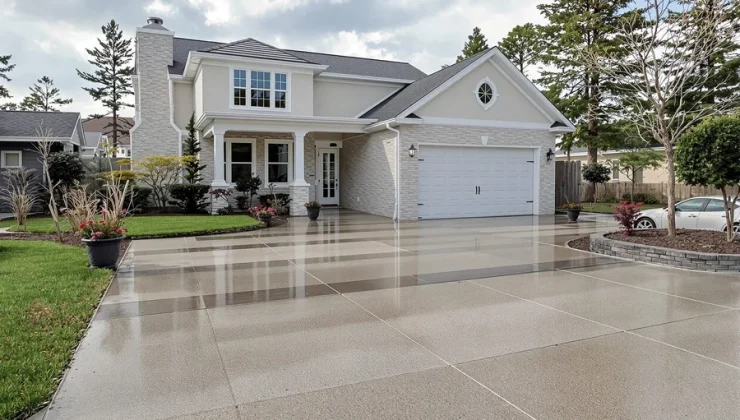
Most slab failures I get called out to inspect in south Louisiana aren’t the concrete’s fault. They’re scheduling decisions. A crew pours a loading pad at 2 p.m. in August because that’s when the truck was free, the mix flashes off before anyone can get a trowel across it, and eighteen months later the property manager is staring at a map of cracks and wondering who to blame.
Concrete doesn’t care what your calendar says. It cares about temperature, moisture, and how fast water leaves the mix. Get those three things right and a well-planned pour can outlast the building it sits beside. Get them wrong in a Louisiana summer and you’ll be patching a parking apron before the landscaping is even established.
This guide covers what actually shortens the life of commercial flatwork around Baton Rouge, how to sequence a project so the weather works with you instead of against you, and when a repair is worth the money versus when you should budget for a replacement.
Why Louisiana Is a Brutal Environment for Concrete
The Gulf South does three things to concrete that most of the country doesn’t experience at the same intensity: sustained heat, heavy seasonal rain, and soil that moves.
Heat is the one people underestimate. When air temperatures sit in the nineties and the sun is directly on fresh concrete, surface moisture evaporates faster than the mix can bleed it to the top. That’s when you get plastic shrinkage cracks, the ones that show up within hours of the pour and look like spiderwebs across the surface. The National Weather Service keeps heat data for the region going back decades, and the pattern is consistent: a long stretch of brutal afternoons from June through September, with humidity that keeps the air heavy but the slab surface hot enough to burn.
Rain is the second problem. A sudden afternoon storm on a slab that hasn’t set adds water to the surface, weakens the top layer, and washes away the finish you just paid someone to apply. You can’t schedule around every thunderstorm in July, but you can schedule around the pattern.
Soil is the third. Much of the Baton Rouge area sits on clay-heavy ground that swells when it’s wet and shrinks when it dries. That movement transfers straight up into anything sitting on top of it. A slab that’s perfectly flat on the day it’s poured can develop edge settlement within a couple of seasons if the subgrade underneath wasn’t prepped correctly.
What Separates a Slab That Lasts From One That Doesn’t
Four variables control almost everything about how long your flatwork survives. I’ve started calling this the pour window, and it’s the first thing I walk clients through before anyone orders a truck.
1. The mix design
A standard residential mix and a mix designed for a commercial loading area are not the same product. Commercial flatwork usually needs a lower water-to-cement ratio, a considered slump, and often an admixture that slows the set so the crew has working time in the heat. The American Society for Testing and Materials publishes the standards that govern how these mixes are specified and tested. If your contractor can’t tell you what slump they’re targeting and why, that’s your first warning sign.
2. Subgrade preparation
This is the part nobody sees and the part that determines whether the slab stays flat. Compaction, moisture conditioning, and proper base thickness matter more in clay soil than almost anywhere else in the country. Cut corners here and no amount of quality concrete on top will save you.
3. Placement timing
In July and August, the practical move is to pour early, sometimes starting before sunrise on larger jobs. Cooler slab temperatures give the crew time to screed, float, and finish without racing the sun. If a contractor insists on a midday pour in the middle of summer because it fits their schedule, push back.
4. Curing, not just drying
Concrete gains strength through a chemical reaction that needs moisture. Letting it dry out too fast stops that reaction early and leaves you with a surface that’s weaker than the design called for. Curing compounds, wet blankets, or plastic sheeting all work. So does simply keeping the person responsible for curing honest about doing it.
Planning a Commercial Pour Around the Weather
Here’s the practical part. If you’re managing a commercial project in the Baton Rouge area, work backwards from these decisions.
- Choose your season deliberately. Late fall through early spring gives you the most forgiving window for large pours. If the project timing is flexible, that’s when to schedule it.
- Build rain days into the schedule. A summer pour schedule with zero slack is a schedule that will slip. Give yourself two to three backup dates on any significant pour.
- Get jointing figured out before the pour, not after. Control joints tell the concrete where to crack. Skip them or space them wrong and it will crack wherever it wants.
- Confirm the drainage plan. Flatwork that ponds water will fail faster than flatwork that sheds it. Slope matters even on surfaces that look level.
- Ask about the cure plan in writing. Vague answers here are a red flag.
Property owners and general contractors around here often end up pulling in a specialty crew for this kind of work. If you’re comparing bids for commercial concrete services in Baton Rouge, ask every contractor the same four questions: what mix are you specifying, how are you prepping the subgrade, when will you pour, and how will you cure it. The answers will separate the real outfits from the guys with a truck and a trowel.
Repair or Replace? A Decision Guide
Not every crack means a failed slab. Here’s how I sort it out on site.
| What you’re seeing | Likely cause | Practical call
|
|---|---|---|
| Fine spiderweb cracks, first few months | Plastic shrinkage from fast surface drying | Usually cosmetic. Seal if water intrusion is a concern. |
| Cracks wider than a credit card, running long distances | Subgrade movement or missing control joints | Investigate the base before you spend money on a patch. |
| Slab edges dropping, water pooling against the building | Soil settlement beneath the perimeter | Structural issue. Repairs to the slab alone won’t hold. |
| Spalling, flaking surface near joints | Overworking the finish or deicing salt exposure | Surface repair is reasonable if the slab is otherwise sound. |
My general rule: if the problem traces back to the base, no surface repair lasts. You’re treating a symptom. If the problem is purely at the surface and the slab is still sitting flat and stable, a repair makes sense and will buy you years.
The National Ready Mixed Concrete Association tracks industry guidance on durability and mix performance, and it’s a useful reference point when a contractor tells you a shortcut is standard practice. It usually isn’t.
Fewer Cracked Slabs, Fewer Surprises
Concrete in south Louisiana isn’t a set-it-and-forget-it material, but it’s not fragile either. It rewards planning. Pick the right season, spec the right mix, prep the ground honestly, cure the slab like you mean it, and you’ll get flatwork that holds up through years of heat and storms.
The projects that go wrong almost always went wrong in the week before the truck showed up, not in the years after. So the real question isn’t whether your concrete can take the Louisiana summer. It’s whether your schedule gave it a fair shot.