What’s the Difference Between Magic Mushrooms and Magic Truffles?
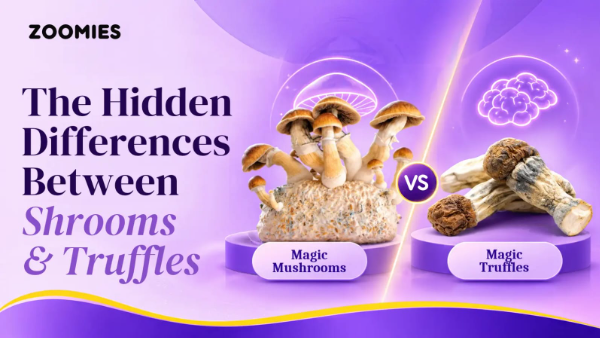
Both contain the same naturally occurring psychedelic compounds, primarily psilocybin and psilocin, but they grow differently and have distinct appearances and potency. Magic mushroom Canada refer to the fruiting bodies of certain fungi that grow above ground, while magic truffles are dense underground structures called sclerotia that the fungus produces to survive harsh conditions. Although they come from the same species in many cases and can produce similar psychedelic effects, they differ in texture, dosage, and cultivation.
What Are Magic Mushrooms?
Magic mushrooms are the fruiting bodies of Psilocybe fungi, the visible, above-ground structures produced by the organism to release and spread spores. Hundreds of species of Psilocybe mushrooms exist worldwide, with well-known examples including:
- Psilocybe cubensis (commonly associated with the “Mexican mushroom”)
- Psilocybe semilanceata(the liberty cap, found in European grasslands)
- Psilocybe azurescens (found along the Pacific Northwest coast of North America).
These mushrooms contain naturally occurring psychedelic compounds, primarily psilocybin and psilocin. They interact with serotonin receptors in the brain and can produce changes in perception and sensory experiences.
Magic mushrooms grow naturally in different environments, including forests, grasslands, and areas rich in organic matter. Their visible mushroom structures develop above ground, while the underground fungal network (mycelium) remains connected to the surrounding substrate. The fruiting body’s primary biological role is reproduction through spore dispersal.
What Are Magic Truffles?
Magic truffles are sclerotia, dense, underground masses of fungal mycelium that the organism uses to store nutrients and survive harsh environmental conditions. They are not true culinary truffles, but specialized structures produced by certain psychedelic fungi. Magic truffles develop underground as part of the same fungal organism.
When conditions become unfavourable, such as limited nutrients, drought, or cold temperatures, some Psilocybe species transform parts of their mycelial network into compact sclerotia.
Magic truffles contain the psychoactive compounds psilocybin and psilocin, similar to those found in magic mushrooms.
Only certain Psilocybe species reliably produce sclerotia. Well-known examples include:
- Psilocybe tampanensis (often called the “Philosopher’s Stone”)
- Psilocybe mexicana
- Psilocybe atlantis
- Psilocybe hollandia
Differences Between Magic Mushrooms and Magic Truffles
The main difference is that magic mushrooms are the above-ground fruiting bodies of the fungus, while magic truffles are underground sclerotia formed by the mycelium as a survival structure.
| Feature | Magic Mushrooms | Magic Truffles |
| Biological structure | Fruiting body of Psilocybe fungi | Sclerotia (dense underground masses of mycelium) |
| Growth location | Grow above ground | Develop underground |
| Primary function | Reproduction and spore dispersal | Survival and nutrient storage |
| Appearance | Have a stem, cap, and gills similar to typical mushrooms | Small, dense, irregular, and truffle-like structures |
| Texture | Soft and mushroom-like when fresh | Dense, firm, and compact |
| Appearance after drying | Often becomes lightweight and brittle | Remains more compact due to its dense structure |
Potency and Dosing
Fresh truffles contain significantly more water than dried mushrooms. A general conversion is that 1 gram of dried psychedelic material contains a similar amount of active compounds as approximately 3 grams of fresh truffles.
Because of this difference in water content, a person comparing 2 grams of dried mushrooms to 2 grams of fresh truffles would not be comparing equivalent amounts. The fresh truffle dose would need to be higher by weight to contain a similar amount of psilocybin.
For microdosing, amounts are generally much smaller. A typical microdose range for dried mushrooms or dried truffles is around 0.1 to 0.3 grams. When using fresh psilocybin truffles, an equivalent amount may be around 0.5 grams.
For larger psychedelic experiences, the same fresh-to-dried conversion applies. For example:
- 2 grams of dried mushrooms ≈ 6 grams of fresh truffles
- 3.5 grams of dried mushrooms ≈ 10–12 grams of fresh truffles
The actual experience can vary significantly because potency is influenced by the specific Psilocybe species, cultivation conditions, storage, and individual sensitivity. Therefore, weight alone does not always predict the intensity of effects.
Do Magic Mushrooms and Magic Truffles Produce the Same Effects?
Yes, magic mushrooms and magic truffles can produce very similar psychedelic effects when they contain equivalent amounts of psilocybin.
However, some users describe subtle differences between the two. Magic truffles are sometimes reported as producing a more grounded, introspective, or earthy experience, while magic mushrooms are sometimes associated with more visual effects or euphoric sensations. These differences are largely based on personal reports and are not consistently observed across all users.
Magic Mushrooms Are More Common Than Magic Truffles in Canada
In Canada, magic mushrooms are far more commonly recognized and discussed than magic truffles. This is largely because magic mushrooms are the more familiar form of psilocybin fungi, with many naturally occurring species found across the country and greater public awareness surrounding their use and research.
While magic truffles contain the same primary active compounds, they are less common in Canada because they are produced by only certain Psilocybe species and are not as widely available or culturally familiar as mushroom varieties.
Even if truffles are not widely available or common in Canada, you can still experience similar effects by choosing magic mushrooms available from Zoomies Canada.
Frequently Asked Questions
Do magic truffles offer the same potential benefits as magic mushrooms in clinical research?
Yes, magic truffles may offer similar potential benefits as magic mushrooms because both contain psilocybin and psilocin.
A 2026 systematic review examining psilocybin magic mushrooms and truffle microdosing found that some studies reported potential benefits related to well-being, mental health, cognition, creativity, relationships, pain, and substance dependence. However, the researchers concluded that the overall certainty of evidence remains low because many studies relied on self-reported outcomes, had methodological limitations, and used different dosing protocols.
Which costs less, magic truffles or magic mushrooms?
In Canada, magic mushrooms are generally cheaper and more widely available than magic truffles. This is because magic truffles are less established in the Canadian market, while psilocybin mushrooms are the more familiar and commonly available form.
Is the Enigma mushroom a truffle or a psilocybin mushroom?
The Enigma mushroom is a psilocybin mushroom, not a magic truffle. It is a cultivated variety of Psilocybe cubensis. The Enigma mushroom is a mutated fruiting body that grows above ground. It has an unusual appearance, often forming dense, brain-like clusters rather than the typical mushroom shape with a cap and stem.