
How to Use GEO to Monitor Competitors in AI Search
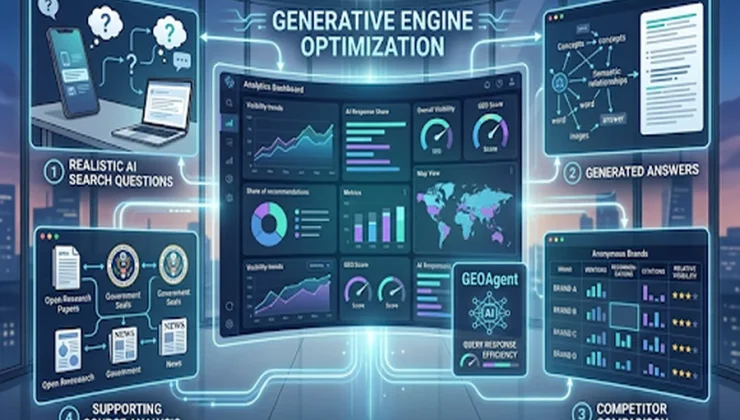
If you want to determine how your rival companies are doing when it comes to AI-related searches, you first need to address the question: “Which company comes to mind for customers when seeking out suggestions and reviews?” This approach differs from standard competitor tracking because it focuses on the customer’s perspective of how companies are perceived based on AI-generated content. Are the competitors being mentioned in people’s recommendations, in the articles, or in the responses made to them, etc.?
The GEO product allows companies to study this phenomenon. Companies can identify the queries posed by customers and determine the frequency of competitor display, their efficiency in terms of subjects and circumstances, and how to improve communication with customers to be present more often.
GEOAgent does this by investigating recommendations, citations, and answers for the keyword being searched. GEOAgent lets organizations use this information to support competitive questions.
Reasons for Monitoring Competitors in the AI Search Field
In the past, it sufficed to conduct research on a competitor’s ranking, links, advertising strategies, and website characteristics; however, AI search has changed things quite a bit. As AI search becomes more packed with information and data that necessitate content generation, search styles continuously change, with people relying more on AI and less on human-generated content. However, research has shown that there are significant differences in how traditional search systems function as compared to the way AI systems function. For instance, AI searchers will often tap into other sites that are relevant to it to help provide valid and reliable information. At other times, they switch reliable third parties depending on the question. Thus, traditional search evaluation criteria will be useless for evaluating AI searches because of these differences in operating principles.
What Should Brands Monitor?
Not every brand’s appearance has the same value. A company may be mentioned without being recommended, listed as one option, directly endorsed, or supported by a citation. These signals should be tracked separately. An effective monitoring process looks at:
Mentions of brands or products.
Recommendations made, either by competitors or people.
Citing or referencing sources.
Position in ranking or visibility.
Questions asked in which a competitor appears but your brand does not.
The frequency of using sources that cite competitors.
The more comprehensive the analysis is, the more information can be gleaned about who is being mentioned, and why there is more visibility with some competitors.
Know What Questions to Monitor for Competition
Monitoring is most effective when it is based on actual consumer demand. The following categories of questions should be included: Information, Comparison, Recommendation, Problem-solving.
If a cybersecurity organization were to monitor for questions, for example, they might track:
What is the best cybersecurity technology and services for small businesses?
What tools are appropriate for remote workers?
How can leading endpoint-related security products be compared?
What should businesses consider in security software?
Being asked this type of question is more valuable than just having an AI ask the question to produce a list of competitors.
Establish a Competitive GEO Baseline
To make changes in content, a baseline must first be established. The same questions should be run across all AI platforms used by the target market. Each run must be documented by noting the date, question asked, response received, names of brands generated, recommendations made, and sources cited.
Being consistent is critical since responses from AI will vary according to the run as well as which platform was used. The generation of search results occurs through several steps, including retrieval, ranking, selection of context, and the citation process. Multiple measurements are key to knowing if there has been an actual change in one’s visibility.
The baseline provides a reference point for future comparisons.
Analyze Competitors with GEOAgent
GEOAgent helps you track competitors by identifying different companies and how they show up as answers to particular questions. You can now distinguish mention-from-us, mention, and referral without concentrating on total score alone. You can also ask similar questions over time so the answers stay reliable and consistent.
Start by defining the brand and its major competitors. Then pick the right intent questions to ask for comparative information (product or recommendation).
Watch for brands that come up often and why. You can learn about competitors’ websites, product specifications, rating sites, press mentions, and instructions, etc. Combining these information sources is more informative than knowing their names.
Make Comparisons by Questions Visibility
Avoid focusing on one total visibility number. One company might perform well in total awareness but not be considered the number-one brand in discussions comparing similar products. Another business may not rank high on the total visibility list, but it may be the only competitor considered when a potential customer asks what to buy. Begin to categorize questions by intent and compare visibility performance results for competitors in each area.
Analyze the Reasons for Competitor Citing
A mention of a competitor does not mean it is based on the competitor’s website. AI platforms may have used all types of references, including reviews, articles, comparisons, interviews, documentation, etc.
Having done this, you get a thorough understanding of the reasons for competitors’ citations to help you define corresponding data sources. Please do not copy the reference on every mention of a competitor.
Measure Changes Over Time
Continue GEO monitoring after content changes. Recheck the same questions under comparable conditions and record changes in mentions, recommendations, and citations.
A single changed answer does not prove that an update caused improvement. AI results vary across runs and platforms.
GEOAgent’s methodology consists of identifying and establishing a baseline, isolating a particular visibility gap, recording the difference, and rechecking what was done in the previous step. These results are classified as validated, failed, or inconclusive.
In Conclusion
Companies can use GEO for observations on AI research about their competitors. Businesses are able to analyze search data trends and identify their competition, how visible they are, and what references they have behind their ranking.
This is done most effectively when there is a clear ongoing baseline, specific targeted questions that need to be asked, and multiple iterations of checking against those questions. GEOAgent allows for the above information to be categorized into mentions, recommendations, citations, and sources.
Use the results for investigative purposes rather than as a fixed order of importance or a guarantee. Companies that use competitive intelligence to improve the relevance, accuracy, and credibility of their content will thrive as AI search evolves.